LEAVE US YOUR MESSAGE
contact us

Hi! Please leave us your message or call us at 510-858-1921

Thank you! Your submission has been received!

Oops! Something went wrong while submitting the form

28
May

Credit Markets in Flux — What Leveraged Loans and Private Credit Shifts Mean for Hospitality Allocators

Last Updated
I
May 28, 2026

Quantamental Read: Hold Regime in Public, Opportunism in Private

Bay Street’s Phase 13 Regime Detection categorizes the current credit landscape as a “Hold Regime” in public markets but an “Opportunistic Deployment Regime” in private credit.

Public Syndicated Loans: Defensive and Price-Sensitive

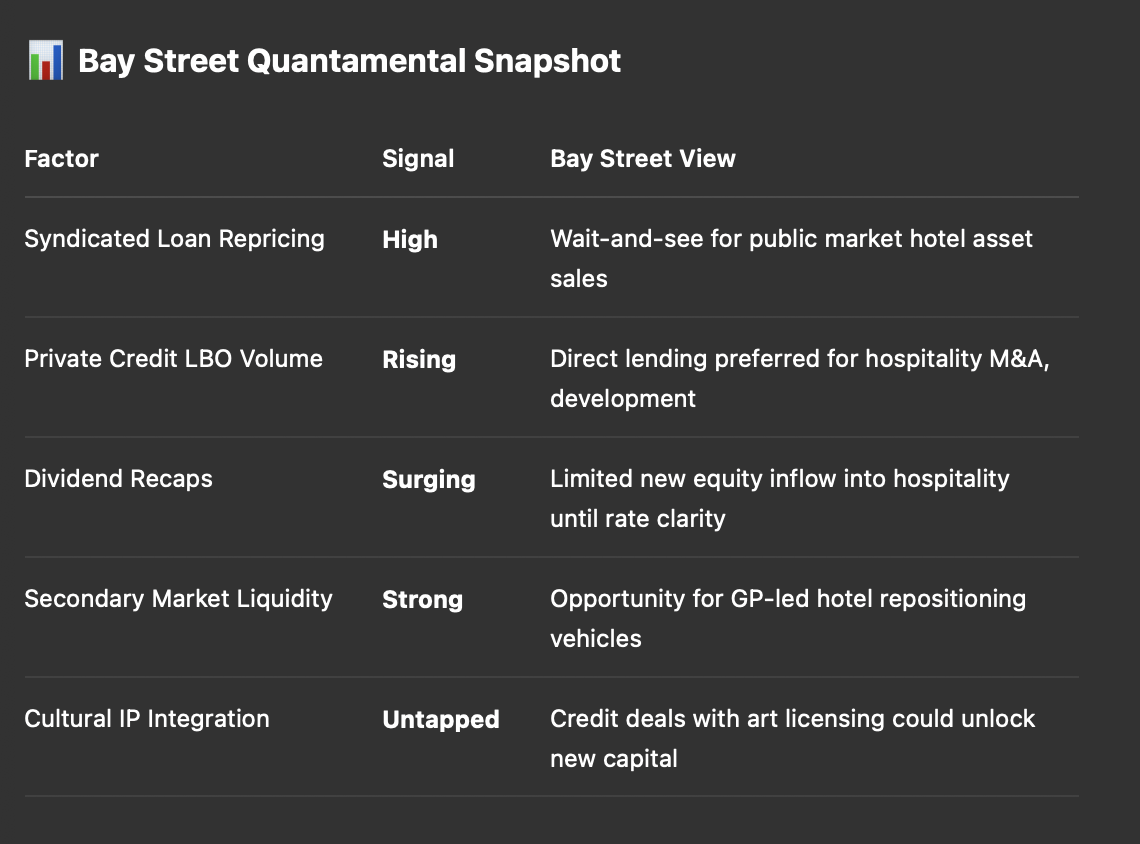
  • Repricings Surge: With $19.3B in syndicated loans repriced this week alone (DaVita, Nord Anglia Education), lenders’ appetite for loan paper remains strong — but it is being traded, not expanded.
  • Dividend Recaps Dominate: Sponsors are avoiding exits, instead extracting value via €4.4B dividend recaps (Froneri) to return capital to LPs.

For hospitality, this means institutional sellers will likely hold prime assets longer, waiting for rate clarity, pushing liquidity toward private bilateral negotiations rather than public auctions.

Private Credit: The Clear Winner

  • Direct Lending Volume Up: Q2 2025 saw $22B in direct lending for LBOs, the highest since Q2 2022. Sponsors prioritize speed, certainty, and flexible terms over the complexity of syndicated loans.
  • Secondary Market Booms: Coller Capital’s $5.8B close for its second private credit secondary fund highlights growing liquidity options for GP-led transactions.

For Bay Street, this signals hospitality development and repositioning projects are more likely to secure financing via direct lenders, GP continuation vehicles, or structured private credit, especially for branded residence and wellness-hospitality hybrids.

Art Licensing and Credit: The Hidden Link

In recent meetings with art families in Zurich, London, and Abu Dhabi, many expressed growing interest in credit-backed hospitality placements:

“We don’t just want equity in hotels; we want credit structures that allow us to influence the narrative while preserving downside protection.”

This mindset mirrors Art Collecting Today:

“The modern collector is a financier of cultural environments, not just an owner of objects.”

Bay Street sees structured credit deals with embedded cultural licensing rights as a potential game-changer — allowing art families to partner with operators, fund CapEx for curated spaces, and benefit from stable cash flows.

Imagine a branded residence or hotel refinancing supported by private credit, with part of the proceeds funding curated art installations or wellness-driven experiential programming — creating both cultural alpha and yield defensibility.
Strategic Takeaway: Credit is Now the Alpha Gateway

Hospitality investors shouldn’t view credit markets as separate from their equity thesis. The reality is credit is shaping who gets to buy, build, or hold hospitality assets in 2025.

The winners will be those who:

  1. Leverage direct lending relationships for rapid deployment into repositioning and branded residence plays.
  2. Use continuation or secondary vehicles to refinance and hold cultural and wellness-led assets through rate volatility.
  3. Partner with art and cultural financiers to integrate narrative-driven programming into credit structures, securing longer-term loyalty and yield premiums.

As Management of Art Galleries reminds us:

“The capital that lasts is the capital that funds meaning.”

For Bay Street, credit isn’t just the cost of capital — it’s now the cost of narrative.

...

Latest posts
7
Jul
Saudi Arabia Hospitality Fund Opportunities Under Vision 2030
July 7, 2026

Saudi Arabia surpassed 122.6 million tourist arrivals in 2025, exceeding Vision 2030's original 100M target three years early. With 29.3M international visitors, USD 2.5B in H1 hotel M&A, a PIF pipeline of USD 3.6B across 3,300 keys, and a Singapore-Saudi DTA providing 5% dividend WHT, this brief covers the bifurcated opportunity -- from stabilised Jeddah assets to giga-project co-investments alongside PIF -- for a Singapore VCC fund.

Continue Reading
5
Jul
Vietnam Hotel Investment: Mid-Market Opportunity for 2026
July 5, 2026

Vietnam's hotel investment market crossed USD 125 million in transaction volume in 2025, with JLL forecasting 2026 as a breakout year for M&A. International arrivals hit a record 21.17 million (+20.4% YoY), RevPAR grew 17.1% nationally, and Phu Quoc grew 60%+ in 1H/2025. The core thesis is the mid-market conversion opportunity: 68% of Vietnam's hotel stock is unbranded and owner-operated, with USD 80-90 ADR assets in secondary cities offering 200-400bps RevPAR uplift via international management contract attachment. Covers transaction yields, supply pipeline, LURC legal framework, Singapore VCC-Vietnam DTA mechanics, and five risk factors.

Continue Reading
3
Jul
Japan Hotel Investment Fund: Inbound Tourism and the Yen Trade
July 3, 2026

Japan led APAC hotel investment in 2025 with USD 2.2 billion YTD through Q3, while setting an all-time inbound tourism record of 42.68 million visitors. Tokyo prime cap rates hit record lows for the twelfth consecutive quarter, yet Tokyo ADR of USD 188.5 remains cheaper than Singapore, London or Paris in dollar terms -- the core of the yen trade thesis for SGD/USD-denominated funds. This post covers transaction volumes, RevPAR performance (15%+ YoY), the 1.7% new supply ratio, Singapore-Japan DTA treaty mechanics, and the five risk factors to model for 2026 vintage investments.

Continue Reading

Unlock the Playbook

Download the Quantamental Approach to Investor Protection, Alignment & Alpha Creation Playbook
Thank you!
Oops! Something went wrong while submitting the form.
Are you an allocator or reporter exploring deal structuring in hospitality?
Request a 30-minute strategy briefing
Get in touch